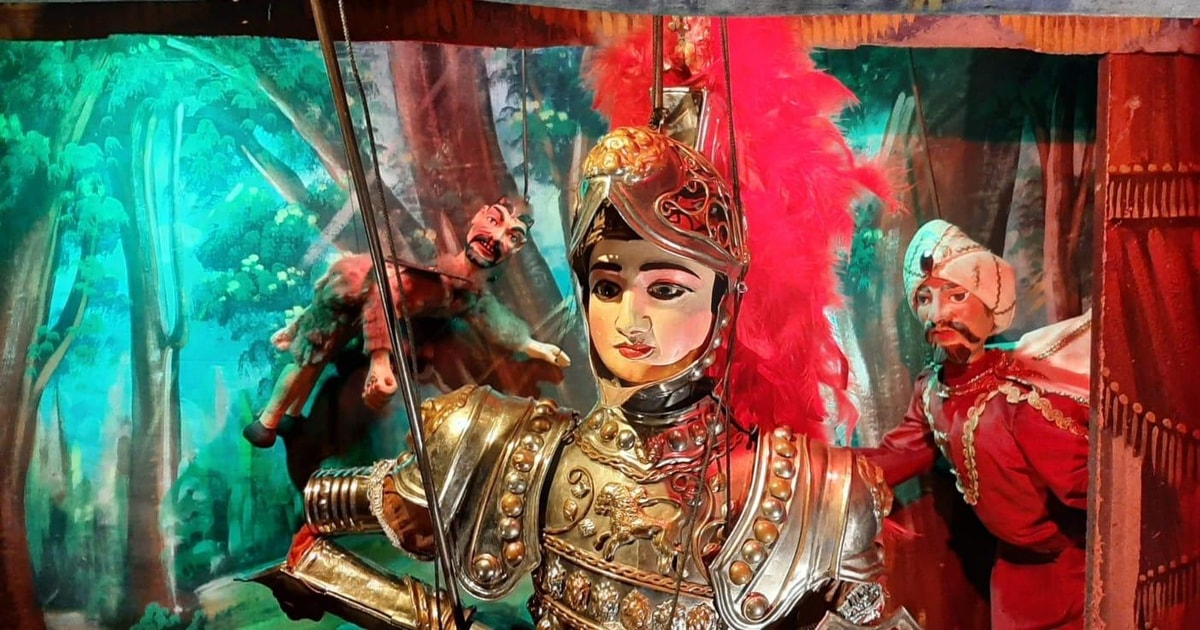
The short answer
Is the Opera dei Pupi in Palermo worth it?
Worth it if you like theatre you can see being made: carved knights in armour, strings and rods, painted sets and a story older than Palermo's cathedral. It scores 4.2 on 42 reviews, a small sample, and starts from US$29 a head for one hour. Pick something else if you want a grand auditorium or a show you can follow word by word without any preparation.
Six things worth knowing
A living tradition, not a prop
UNESCO named the Opera dei Pupi in 2001 and entered it on its intangible heritage register in 2008. It grew up in Sicily in the early 1800s among working families, so you are watching a craft with its own rules, not a costume show invented for visitors.
The plot is borrowed from epics
The stories follow Charlemagne's paladins against the Saracens, drawn from medieval and Renaissance chivalric verse. Knowing that Orlando is the loyal hero and Rinaldo his hot-headed cousin gives you a map before the first duel.
Dialect on stage
Reviewers say the performance runs in Sicilian dialect and that an English libretto is handed out. Treat the libretto as your subtitles and read the outline in the guides first.
An hour, not an evening
The visit runs one hour, so it fits between lunch and a stroll, or before dinner. It leaves the rest of the day open, which suits Palermo's heat and its crowded old centre.
Easy to undo
The booking carries free cancellation with payment later, so the risk of picking the wrong date is small. The calendar lists what is open, and the confirmation names the meeting point.
Seven things behind the puppets
Seven things behind the puppets on the stage
Knowing who is fighting whom, and how the figures work, makes a puppet show far easier to enjoy. Each entry below leans on a named source: UNESCO, Wikipedia or the Pasqualino museum.
-
The cycle
Charlemagne and his paladins
Wikipedia treats the Matter of France as the medieval body of verse and legend gathered around Charlemagne and his paladins, with the Song of Roland among its poems. In those tales Charlemagne is Christendom's champion, so when the puppets fight for him they are playing out that cycle.
-
The heroes
Orlando and Rinaldo
In Ariosto's Orlando Furioso, as Wikipedia summarises it, Orlando is a Christian paladin who loves the pagan princess Angelica and goes mad when she elopes with a Saracen soldier. His cousin Rinaldo loves her too. Their rivalry and loyalty give the pupi plots their engine.
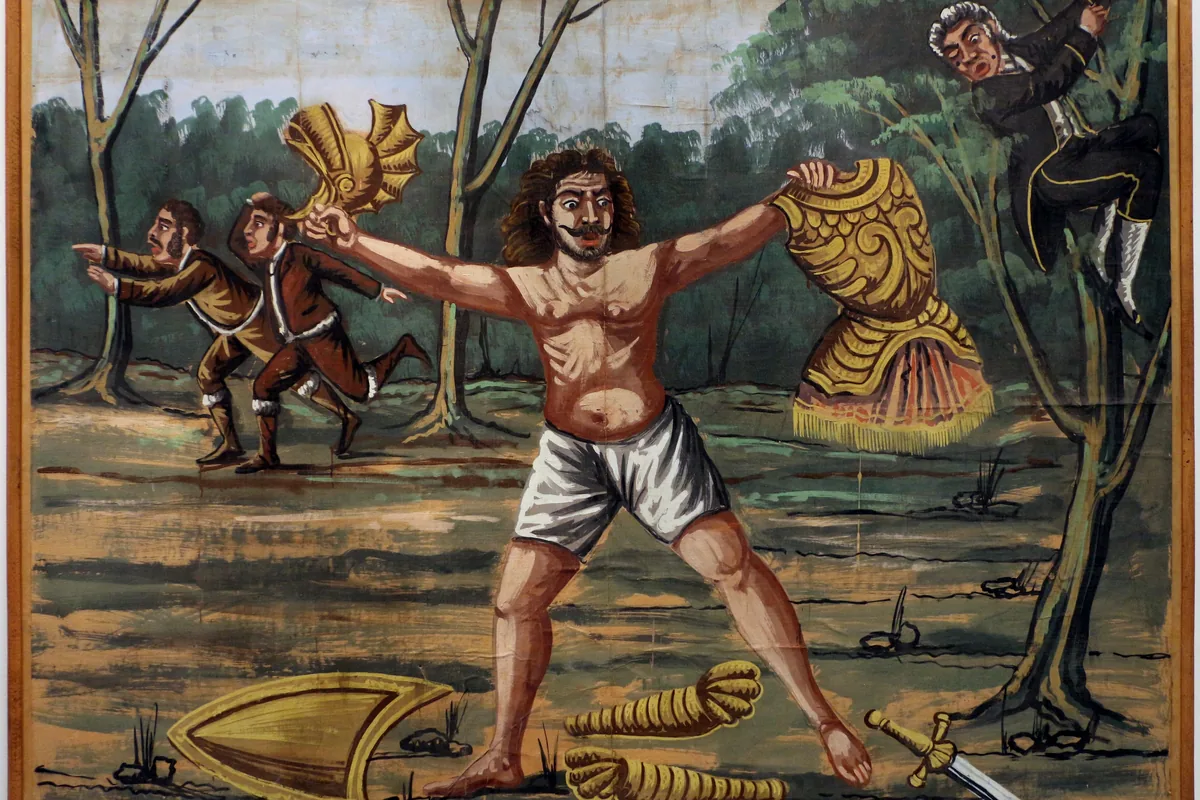
A painted pupi poster showing the madness of Orlando, dated before 1911 (Francesco Bini). -
The source book
The History of the Paladins of France
Wikipedia names Giusto Lo Dico's prose History of the Paladins of France as the compilation behind the repertoire. It reworks Orlando innamorato, Orlando Furioso and Gerusalemme Liberata, which is why a puppeteer could string a long serial out of one text.
-
The faces
Gentle knights, sharp-faced Saracens
Wikipedia says the Christian heroes carry gentle faces and family emblems, while the Saracens have sharper features and wear turbans with half-moon and star motifs. You can read the sides of a duel before a word is spoken.
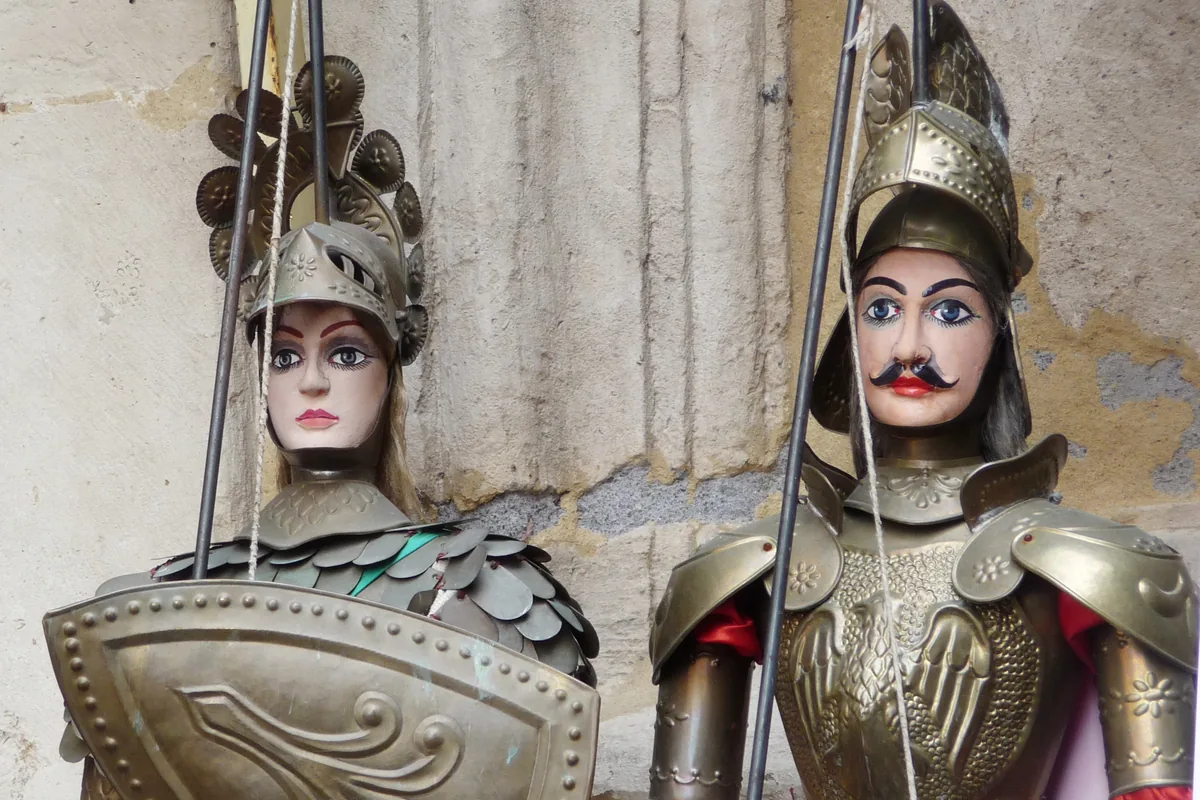
Two pupi photographed in Catania, where the puppets stand taller and heavier than in Palermo (Lucarelli). -
The Palermo build
A puppet of about ninety centimetres
Wikipedia gives Palermo puppets as about 90 cm tall and 5 to 10 kg, with articulated knees. The puppeteer draws and sheathes the sword by a wire through the right hand, and works from the wings at stage level, so the Palermo stage is deeper than it is wide.
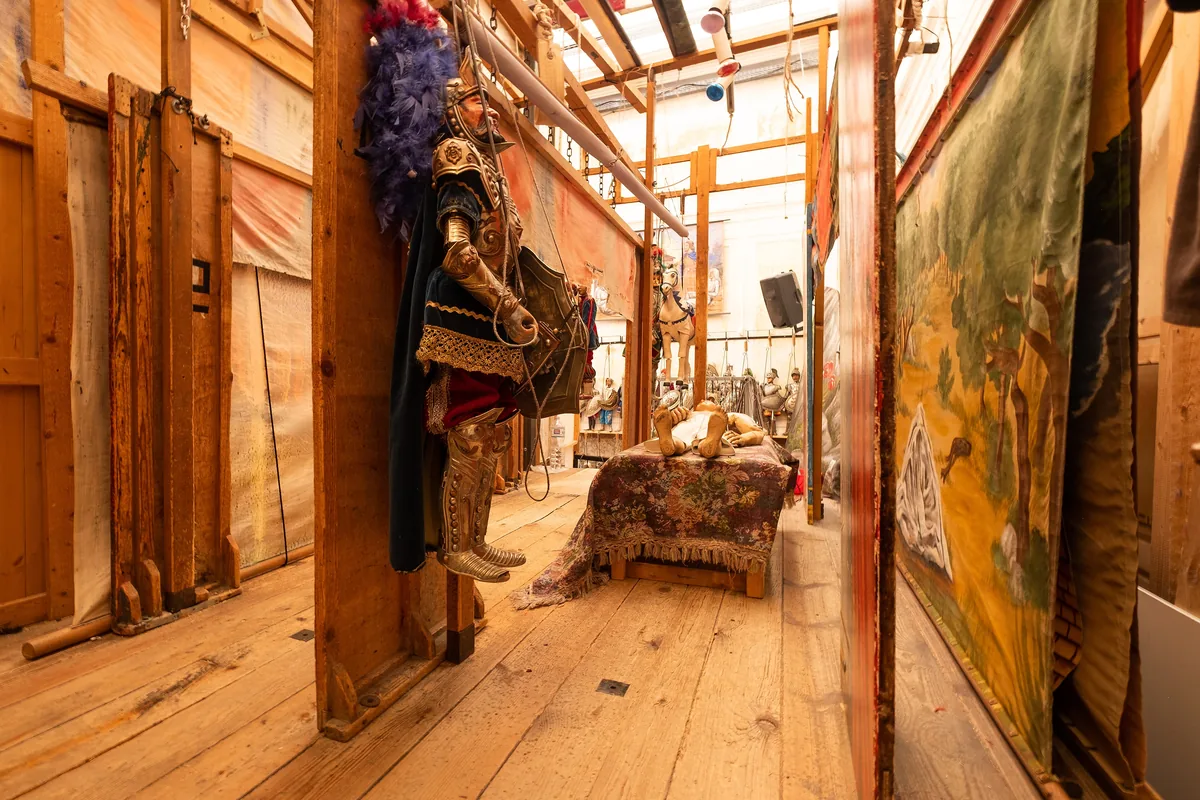
Backstage in the Palermo-school theatre at the Pasqualino museum, where puppeteers work from the wings (Giacomo Bordonaro). -
The families
Family companies and improvised dialogue
UNESCO says the theatres were often family-run, with puppeteers who largely improvised their dialogue and competed to outdo one another, and craftspeople who carved, painted and built the puppets. Wikipedia names Gaetano Greco and Liberato Canino among the Palermo pioneers and the Cuticchio families among Palermo's companies.
-
The comic relief
Nofrio and Virticchio
Wikipedia lists Nofrio and Virticchio as comic figures of the Palermo tradition, where Catania has Peppininu. It adds that Palermo shows used violins for music, later replaced by the barrel organ.
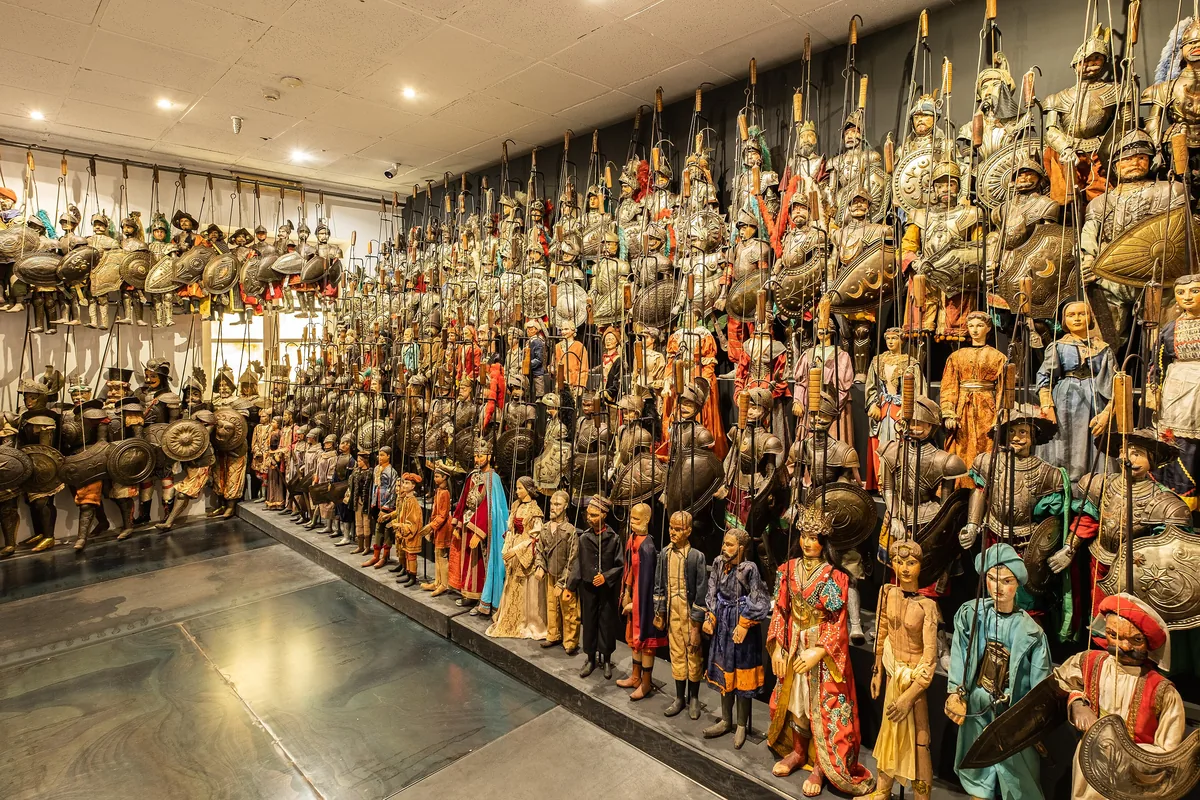
The pupi hall of the Antonio Pasqualino museum in Palermo (Giacomo Bordonaro).
Sources: UNESCO's entry for the puppet theatre, plus encyclopedia pages on the puppet tradition, Charlemagne's literary cycle, Ariosto's poem and the Palermo puppet museum.
A short timeline of the pupi
Eight dates behind the puppets
- 1185
Walter Ophamil, Norman archbishop of Palermo, founds the cathedral
Source note: Wikipedia's Palermo Cathedral article gives the year and the earlier Byzantine basilica on the site
- 1516
Ariosto's Orlando Furioso is first published
Source note: The complete 46-canto version followed in 1532, says Wikipedia
- 1820s
The Opera dei Pupi takes shape in Sicily
Source note: Wikipedia says it dates to the third decade of the nineteenth century; UNESCO says early in the nineteenth century
- 1828
The date of the oldest puppet in the Pasqualino museum
Source note: A Palermo-school puppet named Carinda, says Wikipedia
- 1897
The Teatro Massimo opens with Verdi's Falstaff
Source note: Opened 16 May 1897, says Wikipedia
- 1975
The Pasqualino puppet museum is founded
Source note: Set up by the Association for the Conservation of Popular Traditions, which Antonio Pasqualino founded in 1965
- 2001 and 2008
UNESCO proclaims, then inscribes, the Opera dei Pupi
Source note: The proclamation came in 2001 and the listing in 2008, says UNESCO's page
- 2015
Arab-Norman Palermo and the cathedral churches of Cefalù and Monreale join the World Heritage List
Source note: Palermo Cathedral is one of the component buildings, says Wikipedia
What the booking page covers
Reading the booking page closely
These six points summarise the booking page on 19 November 2026. If it says nothing on a point, this guide stays quiet too.
See open dates ↗The from-price was read on the day of writing; the live fare for your date appears in the calendar.
- The setting
- A historic theatre in the UNESCO area around Palermo Cathedral, in the old centre.
- The performance
- An Opera dei Pupi show built on the deeds of the paladins, with duels, magic, hand-painted sets and the puppeteer's craft.
- The route
- After the show, a route through the craftsmanship and culture of the tradition, which UNESCO recognises as living heritage.
- Languages
- A guide who speaks Italian, Spanish, English, French or Portuguese. Reviewers add that the show is in Sicilian dialect and an English libretto is provided.
- Terms
- Free cancellation, pay later and a one-hour length. The booking widget also tags the visit wheelchair accessible and shows a ten-hour booking cut-off.
- What goes unsaid
- No food, drinks or transport are named, so treat all three as not included. Check the accessibility details on the page itself before relying on them.
Puppets or the opera house
A puppet show or the Teatro Massimo tour?


Reserve the puppets, then fill the other Palermo hours
Other Palermo bookings to set beside it
The puppet hour is short, so it slots in beside bigger plans. Three more Palermo bookings sit next to it: a tour of the opera house, a street food walk and a walk on the anti-mafia movement.
- Check dates ↗
Opera dei Pupi performance and tradition route
A live Opera dei Pupi performance in a historic theatre in the Palermo Cathedral area, then a route through the craft behind it.
- Check dates ↗
Teatro Massimo guided tour
A guided visit to the opera house that is one of Palermo's best-known buildings, according to its booking page. It suits a daytime slot beside an evening or morning of puppets.
- Check dates ↗
Street food and history walk
A small-group guided walk through the old town and its markets, with street food to taste along the way, going by its booking page.
- Check dates ↗
No Mafia walking tour
A guided walk through the historic centre on the mafia and the civil anti-mafia movement, with local resistance efforts, says its booking page.
Also bookable in Palermo
Before the curtain rises
Four things to settle first
Pick a date
Choose a performance in the calendar. The confirmation message repeats the meeting details, so there is nothing to write down.
Read the plot outline
The show runs in Sicilian dialect, say reviewers, with an English libretto handed out. Ten minutes with the Orlando and Rinaldo guide makes the libretto much easier to follow.
Check access and age details
The booking widget tags the visit wheelchair accessible. Age guidance and access detail sit on the booking page, so read them there before you commit.
Pair it with a bigger plan
An hour of puppets leaves a day free. The Teatro Massimo tour suits a different slot, and the street food walk or the anti-mafia walk takes a morning or afternoon.
Armour, strings and painted sets
Armour, strings and painted sets
Photographs from Wikimedia Commons: Palermo-school puppets in armour, a museum hall of pupi, a company at work, a painted poster, a stage from behind, the cathedral and the Teatro Massimo.


More reading
Six reads on the knights, the craft and the city
- Start here Is the Opera dei Pupi in Palermo worth it? What 4.2 across 42 reviews tells you A one-hour puppet performance in a historic theatre near Palermo Cathedral, weighed against its score, its dialect and its short length. Read →
- The comparison A puppet show or the Teatro Massimo tour: which Palermo theatre? A small puppet theatre by the cathedral set against Italy's largest opera house, compared on format, building, language and what each leaves out. Read →
- Reading the stage Orlando, Rinaldo and Charlemagne's paladins: who the puppets play A plain outline of the heroes, the villains and the poems behind a Sicilian puppet show, so the plot makes sense before the first duel. Read →
- The craft Palermo and Catania puppets: how the two Sicilian schools differ Size, weight, knees, swords and stage shape: what separates the Palermo school of pupi from the Catania school, according to UNESCO and Wikipedia. Read →
- The craft How a Sicilian puppet is built, dressed and worked on stage Who makes a pupo, what makes the Palermo type distinct and how a puppeteer controls the sword, from UNESCO and Wikipedia. Read →
- History UNESCO, the pupi and the fight to keep Sicilian puppet theatre alive How a nineteenth-century working-class art was proclaimed, inscribed and revived, with the dates that UNESCO and Wikipedia give. Read →
FAQ
Questions to settle before you pick a day
Is the Opera dei Pupi in Palermo worth it?
Yes, if you like live craft. The booking page shows 4.2 stars over 42 reviews, a thin sample, for a puppet show plus a route through the craft in about an hour. It suits a short, theatrical visit better than a long evening.
What language is the show in?
Reviewers say the performance is in Sicilian dialect and that an English libretto is provided. The booking page lists guides in Italian, Spanish, English, French and Portuguese.
How long does it last?
One hour, says the booking page. It covers the performance and the route through the craftsmanship and culture of the tradition.
Where is the theatre?
The booking page puts it in a historic theatre in the UNESCO area around Palermo Cathedral, and your confirmation message names the exact meeting point.
Can I cancel?
Yes: free cancellation and pay later apply. The widget also shows a ten-hour cut-off, so book ahead of the day.
Is it wheelchair accessible?
The widget tags it wheelchair accessible. Read the access details on the booking page before booking, as they have the final word.
Is it good for children?
Puppets and duels tend to appeal to children, but the booking page carries the age guidance. Check it there, and keep in mind that the show runs in Sicilian dialect.
Are food, drinks or transport included?
None of the three is named on the booking page, so treat them as not included and plan your own way to the theatre.
Should I see the puppets or tour the Teatro Massimo?
They suit different tastes: the puppets give you folk craft in an hour, while the opera house gives you grand architecture. Our comparison guide lays out the differences, and both fit into one stay.